If you walked into a Toys “R” Us between 2001 and 2003, you probably saw a wall of bright orange and red boxes featuring a square-jawed cartoon hero named Jack Stone. He was a firefighter. He was a pilot. He was a police chief. Mostly he was a lesson.
What was Jack Stone, really?
The Jack Stone line was LEGO’s response to a strategic worry: kids were spending less time on long, complex builds and more time on fast play patterns favored by competitors like Playmobil and Hasbro. LEGO’s solution was a sub-brand built around giant pre-assembled elements, simplified instructions, and large molded character figures roughly twice the size of standard minifigures.
A typical Jack Stone set had perhaps 30–50 pieces, most of them mono-purpose specialty molds: a windshield, a chassis, a single-piece roof. The build time was minutes, not hours. The end result barely looked like LEGO.
That was the point — and also the problem.
Why it failed
Several issues, all of them now considered foundational lessons inside LEGO:
-
It abandoned the System. The “LEGO System” — the principle that every brick connects to every other brick across decades of compatibility — is the single most valuable thing LEGO owns. Jack Stone elements were largely incompatible with the rest of the catalog. A child who finished a Jack Stone set could not extend it with their existing LEGO collection. The play loop ended where the box ended.
-
The figures were ugly. This is subjective but consistent across retrospective interviews — the Jack Stone “macro figures” were cartoonish in a way that didn’t appeal to the kids LEGO was trying to capture, and actively repelled the parents (and AFOLs) who buy most LEGO.
-
Retailers stocked it as LEGO. Which meant LEGO bought premium shelf space with a product that didn’t sell at premium velocity. Toys “R” Us and Wal-Mart marked it down aggressively. Margins collapsed.
-
It signaled brand confusion. Sitting next to a Bionicle box and a Star Wars UCS X-Wing, Jack Stone made the LEGO brand feel directionless. Strategic clarity is not visible in any one set, but it’s catastrophically visible across an aisle.
The 4 Juniors footnote
Jack Stone was discontinued in 2003 as part of the post-Knudstorp cleanup, but a quieter cousin — LEGO 4 Juniors — survived for several more years targeting the same age group with similar simplified builds. 4 Juniors got a less brutal reception (it kept the System intact) and eventually morphed into what we now know as the LEGO Juniors and LEGO 4+ lines. Those lines still exist; they just learned the Jack Stone lesson — keep elements compatible with the rest of the catalog.
The collector market for Jack Stone
There basically isn’t one. A few completist AFOLs collect Jack Stone for camp value or because they’re tracking every LEGO theme ever produced. A handful of unopened sets occasionally surface on eBay for $30–80 — about the same as their original retail. There is no aftermarket appreciation.
This is the cleanest empirical signal you’ll find that “rare” doesn’t equal “valuable.” Jack Stone is rare. It’s also unwanted. The market is honest.
What LEGO learned
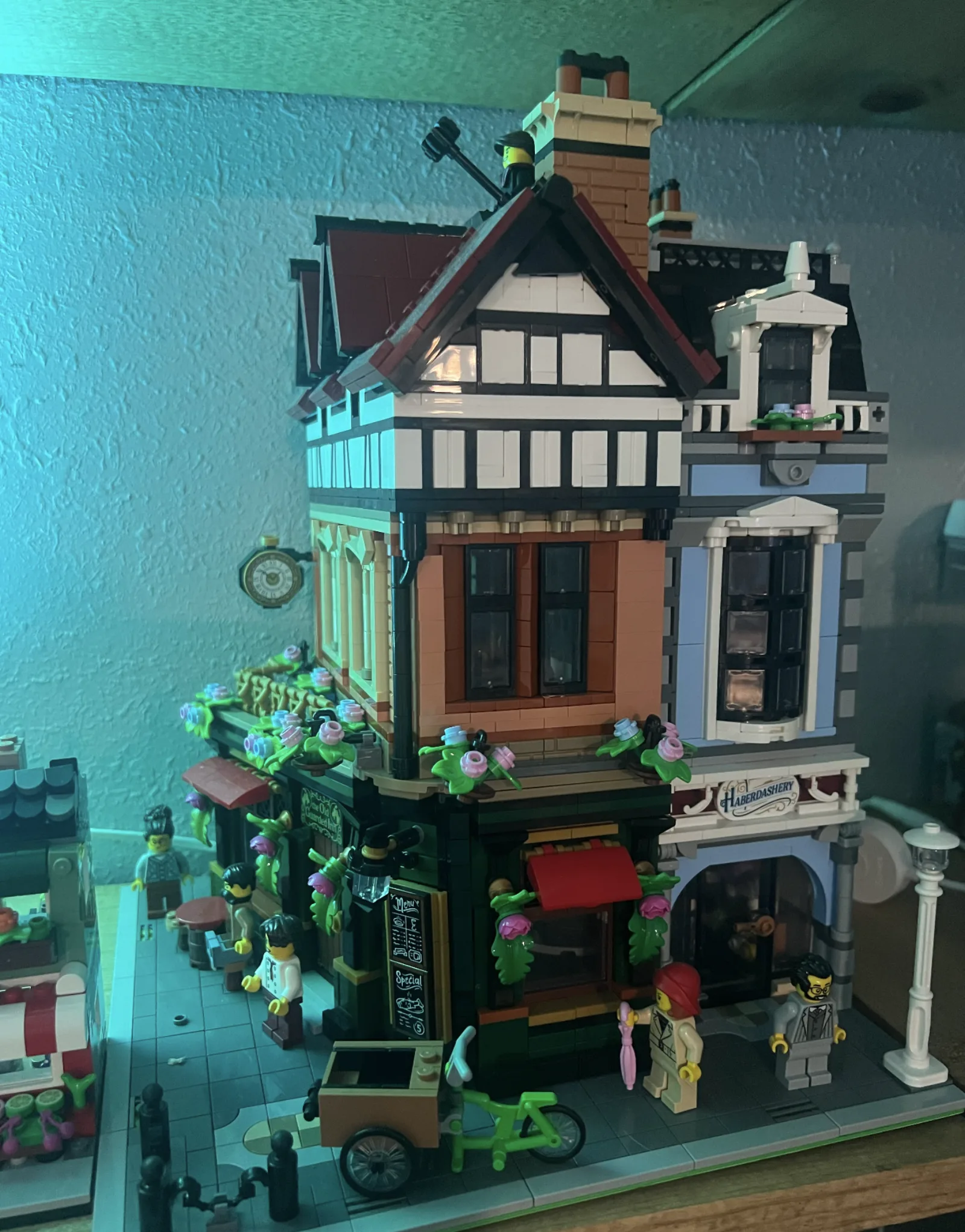
Inside LEGO, “Jack Stone” is now used as a verb — as in “let’s not Jack Stone this idea.” It refers specifically to the failure mode of solving a strategic worry by abandoning the brand’s defining strengths instead of leaning on them. The 2007 Modular Buildings line is, in many ways, a direct correction: a long, complex, deliberately AFOL-courting product that doubled down on the System rather than running from it.
The Cafe Corner is up 4,500% on the secondary market. A boxed Jack Stone Fire Heli is up zero. The lesson took.