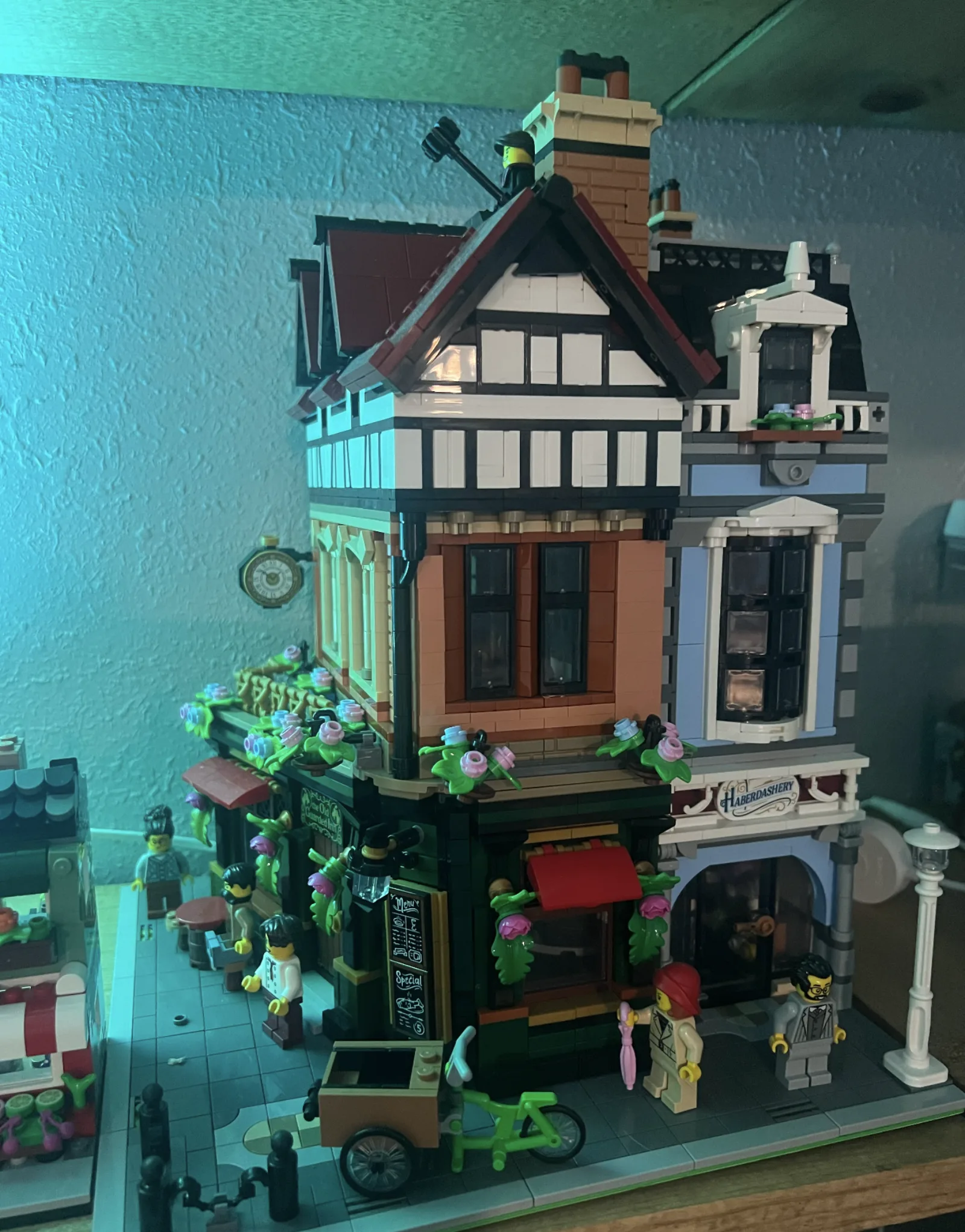
If you ask experienced collectors which LEGO sets are most likely to gain value, you’ll hear the same answer almost every time: modulars. The phenomenon is consistent enough that it has a nickname — the Cafe Corner curse — and it’s been holding for nearly two decades.
It’s real. Here’s why.
The cycle
The Modular Buildings Collection launched in 2007 with 10182 Cafe Corner and has continued at a near-annual cadence ever since: one new modular per year (mostly), retiring on roughly a four-to-five-year window, never re-issued. The full lineage:
- 10182 Cafe Corner (2007) — retired 2011 — ~17× MSRP
- 10185 Green Grocer (2008) — retired 2011 — ~10×
- 10190 Market Street (2007, Factory) — retired 2008 — ~16×
- 10197 Fire Brigade (2009) — retired 2014 — ~6×
- 10211 Grand Emporium (2010) — retired 2015 — ~5×
- 10218 Pet Shop (2011) — retired 2015 — ~4×
- 10224 Town Hall (2012) — retired 2016 — ~5×
- 10232 Palace Cinema (2013) — retired 2017 — ~3×
- 10243 Parisian Restaurant (2014) — retired 2018 — ~3×
- 10246 Detective’s Office (2015) — retired 2019 — ~3×
- 10251 Brick Bank (2016) — retired 2020 — ~2.5×
- 10255 Assembly Square (2017) — retired 2022 — ~2×
Every retired modular trades above retail. The pattern hasn’t broken since 2007.
Why it keeps happening
Five structural reasons:
-
AFOLs collect the whole set. The Modular line is explicitly a connected city — every set shares the same scale, base footprint (32×32 studs), and architectural language. Once a collector commits to one, they generally want all of them. That creates persistent demand for every previous release simultaneously, not just the current one.
-
Re-issuing is functionally impossible. Modulars use unique molds, unique color combinations, and fairly esoteric element counts. Re-issuing one would (a) signal that LEGO might re-issue any of them, instantly cratering the entire secondary market, and (b) require massive tooling investment for a niche AFOL audience. LEGO has, to date, never re-issued a retired modular. The decision appears to be deliberate.
-
The build experience is excellent. Modulars are routinely cited by AFOLs as the best sets in the LEGO catalog. Build hours run 8–15+. The end result is large, displayable, and connectable. Demand isn’t speculative — it’s driven by people who actually want to build them.
-
Boxes are huge. Modular boxes are among the largest in the LEGO catalog. Sealed examples are physically annoying to store. That makes sealed survivorship lower than for smaller sets — which compounds the supply squeeze on the resale market.
-
The audience has money. Modular buyers are predominantly adult collectors with discretionary income. The audience can afford to bid prices up. This isn’t true of all LEGO themes — Friends and Duplo, for instance, see almost no aftermarket appreciation regardless of rarity.
What the data tells us about future picks
The current modular range that hasn’t yet retired:
- 10260 Downtown Diner (2018) — already retired — ~2×
- 10264 Corner Garage (2019) — already retired — ~1.8×
- 10270 Bookshop (2020) — recently retired — ~1.5×
- 10278 Police Station (2021) — late lifecycle
- 10297 Boutique Hotel (2022) — mid lifecycle
- 10312 Jazz Club (2023) — mid lifecycle
- 10326 Natural History Museum (2024) — early lifecycle
The historical pattern says the Boutique Hotel and Police Station are the next two retirements that should appreciate at the typical 2–4× window. Neither is a guaranteed bet — past performance, etc. — but the structural conditions that produced the curse for 17 years are still in place.
The investment caveats
A few honest cautions:
- Sealed condition matters disproportionately. Built modulars sell for a fraction of sealed ones — sometimes 30%. Box damage drops sealed-set value by 20–40%.
- Storage is real cost. A sealed modular takes up the volume of a small piece of furniture. Climate, humidity, sunlight, and crushing all degrade boxes.
- Liquidity is poor. Selling a $2,500 set takes weeks. eBay fees, shipping costs, and the risk of disputes eat 10–15% of headline price.
- The market can break. A single LEGO re-issue would cause prices to collapse instantly. A broader collapse in AFOL spending power would soften the entire category.
If you’re buying modulars for the joy of owning them, none of this matters — buy the ones you love. If you’re buying them as an investment, the curse is real, the math has been consistent for 17 years, and the most valuable list shows you exactly where the previous winners ended up. Just don’t pretend the future is guaranteed.